

A herniated disc can cause more than back or neck discomfort. When displaced disc material irritates or compresses a nearby nerve, symptoms may include pain that travels into an arm or leg, numbness, tingling, or muscle weakness.
If you are looking for conservative treatment options, you may have come across spinal decompression for a herniated disc. Non-surgical spinal decompression uses controlled traction to gently stretch areas of the spine. It is intended to change mechanical forces through the spine and may be considered as part of a broader treatment plan for selected patients.
However, spinal decompression is not appropriate for every herniated disc, and it should not be presented as a guaranteed way to repair or cure a damaged disc. Understanding your symptoms and getting an appropriate evaluation should come first.
What Is a Herniated Disc?
Your spine contains a series of bones called vertebrae. Between most of these bones are intervertebral discs that provide cushioning and help the spine move.
Each disc has a tougher outer layer surrounding a softer center.
A herniated disc occurs when material from inside the disc pushes through or disrupts part of its outer layer. If that material irritates or compresses a nearby nerve root, symptoms can develop along the pathway of the affected nerve.
Herniated discs are commonly associated with the lower back, although they can also occur in the neck.
Not every herniated disc causes symptoms. Some people have disc changes visible on imaging without experiencing significant pain. This is one reason treatment decisions should consider both examination findings and symptoms rather than relying on an imaging result alone.
What Symptoms Can a Herniated Disc Cause?

Symptoms depend partly on where the affected disc is located and whether nearby nerves are involved.
A lumbar herniated disc may cause lower back pain along with discomfort that travels through the buttock and leg. When a nerve contributing to the sciatic nerve becomes irritated, symptoms may be described as sciatica.
Other possible symptoms include numbness, tingling, burning sensations, and weakness in part of the leg or foot.
A herniated disc in the neck may produce neck discomfort along with symptoms that travel into the shoulder, arm, or hand.
The intensity of these symptoms can vary considerably. Some people experience mild discomfort, while others find sitting, walking, lifting, sleeping, or working difficult.
Because several conditions can produce similar symptoms, a proper evaluation is important before deciding on treatment.
What Is Non-Surgical Spinal Decompression?
Non-surgical spinal decompression is a form of motorized traction.
During treatment, the patient typically lies on a specialized table while a controlled pulling force is applied to a targeted area of the spine. The amount and direction of traction can be adjusted according to the treatment plan and the equipment being used.
The general purpose is to gently change mechanical loading through the spine.
You may see claims online that decompression definitively “puts a disc back into place” or permanently repairs a herniated disc. These claims oversimplify what happens inside the spine and go beyond what can reasonably be promised from treatment.
A more appropriate way to view spinal decompression therapy is as one conservative option that may be considered for selected patients as part of a broader care plan.
How Could Spinal Decompression Help a Herniated Disc?
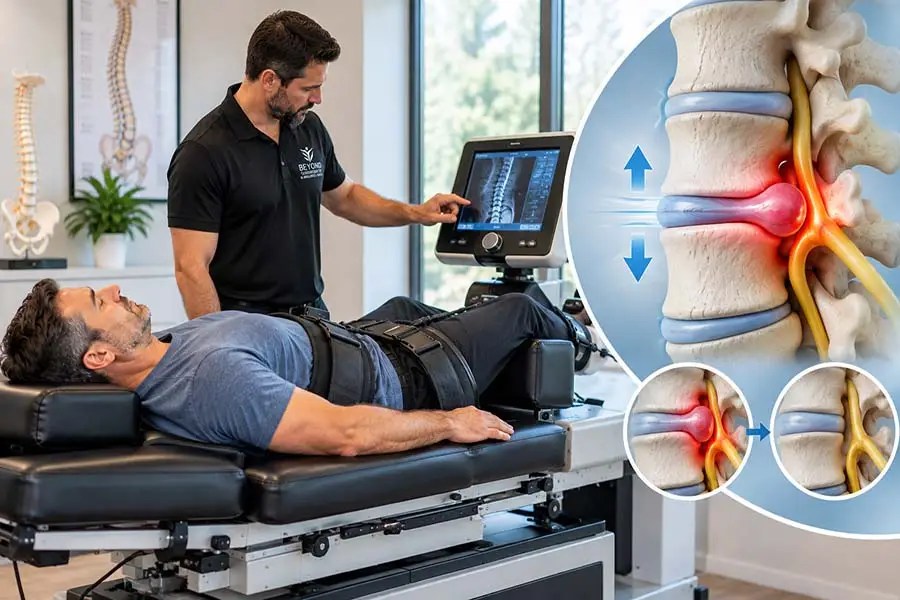
The rationale behind spinal decompression involves applying controlled traction to temporarily alter forces through the affected spinal region.
For someone with a herniated disc, the goal may be to reduce mechanical stress and improve comfort while the condition is managed conservatively.
Some patients report reduced pain or improved function with traction-based treatments. However, research on non-surgical spinal decompression is mixed, and evidence does not support guaranteeing that the treatment will heal or reverse a herniated disc.
Results can also vary because herniated discs differ considerably between patients.
The location and extent of the disc problem, the nerve involved, how long symptoms have been present, and the person’s overall health can all affect the treatment approach.
For that reason, spinal decompression should be considered based on an individual evaluation rather than automatically recommended whenever an MRI mentions a herniated disc.
Is Spinal Decompression the Same as Traction?
The terms are sometimes used interchangeably, but they can refer to somewhat different treatment methods.
Traditional spinal traction uses a pulling force intended to stretch or unload parts of the spine. Traction can be performed manually or with mechanical equipment.
Non-surgical spinal decompression generally refers to motorized traction delivered through a specialized table or device using controlled cycles of tension and relaxation.
Marketing descriptions sometimes present decompression as entirely different from traction. In practice, both approaches rely on traction principles.
The equipment, treatment settings, positioning, and protocols may differ, but patients should be cautious about claims that a particular machine can guarantee disc healing simply because it is marketed as “decompression.”
Who May Be Considered for Spinal Decompression Therapy?

Spinal decompression may be considered for certain patients experiencing back or neck symptoms associated with disc-related conditions.
The decision should be based on more than pain alone.
Before recommending treatment, a healthcare provider should review your symptoms, medical history, previous injuries, medications, and relevant medical conditions. A physical examination may also assess mobility, strength, sensation, reflexes, and signs of nerve involvement.
Existing imaging may be reviewed when clinically relevant. However, imaging is not automatically necessary for every episode of back pain.
At Beyond Chiropractic & Wellness Center, the goal of an evaluation is to understand the individual patient before determining whether Spinal Decompression Therapy or another conservative approach is appropriate.
What Happens During a Spinal Decompression Session?
The exact process depends on the equipment being used and the area of the spine being treated.
Typically, you lie on a specialized treatment table. A harness or positioning system may be used to help direct the traction force toward the appropriate spinal region.
The machine then applies controlled traction according to settings selected by the provider.
Treatment should not involve simply choosing the same settings for every patient. The force and treatment plan need to take into account factors such as the patient’s condition, symptoms, tolerance, and response.
You should communicate with your provider about how you feel during treatment, particularly if symptoms substantially increase or change.
How Many Spinal Decompression Sessions Are Needed?
There is no universal number of sessions that works for every herniated disc.
Your treatment plan depends on factors such as the severity and duration of symptoms, examination findings, overall health, response to treatment, and whether other therapies are being used.
Progress should be monitored rather than assuming that every patient needs a predetermined package of treatments.
A meaningful improvement may involve more than simply reporting a lower pain score.
Your provider may also consider whether you can sit, walk, work, sleep, exercise, or perform normal daily activities more comfortably.
If treatment is not producing meaningful improvement, the plan should be reassessed.
Is Spinal Decompression Painful?
Non-surgical spinal decompression is generally intended to be a controlled treatment rather than a painful procedure.
Patients may notice a stretching or pulling sensation during traction. Individual experiences can differ depending on the condition being treated and sensitivity of the affected area.
You should tell your provider if treatment causes significant pain, increased numbness, new weakness, or a substantial worsening of symptoms.
More treatment intensity is not necessarily better.
A conservative treatment plan should be adjusted according to how the individual responds rather than pushing through worsening neurological symptoms.
Can Spinal Decompression Be Combined With Chiropractic Care?

Depending on the patient, spinal decompression may be only one part of a broader conservative care plan.
Some patients may also receive Chiropractic Care, mobility work, rehabilitation exercises, physiotherapy, or other treatments based on their examination findings and needs.
For example, treatment may initially focus on making movement more comfortable. As symptoms improve, exercise and rehabilitation may become increasingly important for restoring strength, mobility, and confidence with everyday activities.
This combined approach also recognizes that a herniated disc is not simply an image on a scan.
Treatment should consider the person as a whole, including how symptoms affect movement, work, exercise, sleep, and everyday function.
Can a Herniated Disc Heal Without Surgery?
Many people with symptomatic lumbar disc herniation improve without surgery.
Conservative management can include staying appropriately active, exercise or rehabilitation, medications when medically appropriate, and other treatments depending on the patient’s symptoms.
The body can also change over time. Research using follow-up imaging has documented spontaneous reduction or resorption of some herniated disc material.
This does not mean every disc herniation will disappear or that everyone will recover on the same timeline.
It does show why finding a herniated disc does not automatically mean surgery is necessary.
Surgery may still be considered when symptoms are severe, neurological problems are progressing, or appropriate conservative treatment has not provided sufficient improvement.
When Should You Seek Medical Care for a Herniated Disc?

Back pain associated with a herniated disc is often managed conservatively, but certain symptoms require prompt medical attention.
Seek emergency medical care if you develop new problems controlling your bladder or bowels, numbness around the genitals or inner thighs, or severe or rapidly worsening weakness in the legs.
These symptoms can be associated with cauda equina syndrome, which is rare but requires urgent medical assessment.
You should also seek appropriate medical evaluation for significant or progressive weakness, symptoms following major trauma, fever with back pain, unexplained weight loss, or back pain accompanied by other concerning health changes.
A responsible provider should recognize when conservative care is appropriate and when referral for medical evaluation is necessary.
Spinal Decompression for Herniated Disc in Reston, VA
If a herniated disc is affecting your work, sleep, exercise, or everyday activities, the first step is understanding your condition and available treatment options.
At Beyond Chiropractic & Wellness Center in Reston, VA, we evaluate your symptoms, health history, movement, and relevant examination findings before recommending treatment.
Depending on your condition, conservative care may include Spinal Decompression Therapy, Chiropractic Care, Physiotherapy, or another approach appropriate for your individual needs.
Spinal decompression is not right for everyone, and we do not believe every person with back pain should receive the same treatment.
If you are considering spinal decompression for a herniated disc in Reston, VA, contact Beyond Chiropractic & Wellness Center to schedule an evaluation and discuss whether this treatment may be appropriate for you.
Frequently Asked Questions
Does spinal decompression fix a herniated disc?
Spinal decompression should not be described as a guaranteed way to fix or permanently repair a herniated disc. It is a conservative traction-based treatment that may help selected patients manage symptoms. Herniated discs can also change naturally over time.
Is spinal decompression good for a herniated disc?
It may be considered for some people with disc-related back or neck symptoms. Whether it is appropriate depends on the person’s symptoms, health history, examination findings, and other factors. Not every herniated disc requires decompression treatment.
Can spinal decompression make a herniated disc worse?
People can respond differently to treatment. Significant increases in pain, numbness, weakness, or other neurological symptoms should be reported to the treating provider. Appropriate screening and monitoring are important.
How long does spinal decompression take to work?
There is no guaranteed timeline. Some people may notice changes during a course of conservative treatment, while others may not respond sufficiently. Progress should be evaluated based on symptoms and improvements in everyday function.
Is spinal decompression better than chiropractic adjustments?
One treatment is not automatically better than the other. The appropriate approach depends on the patient’s condition, symptoms, health history, and examination findings. In some cases, different conservative treatments may be used together.
Do all herniated discs require treatment?
No. Some disc herniations cause few or no symptoms, and many symptomatic cases improve with conservative management. Treatment decisions should be based on the patient’s symptoms and functional limitations rather than imaging findings alone.
Can spinal decompression prevent herniated disc surgery?
It cannot be guaranteed to prevent surgery. Many people with herniated discs improve without surgery, but some cases require surgical evaluation, particularly when neurological problems are severe or progressive or conservative treatment has not been successful.
Related Reading
Learn more about Spinal Decompression Therapy and explore our resources on Back Pain, Sciatica, Chiropractic Care, and Physiotherapy.
You can also read What Does a Chiropractor Do for Sciatica? if your disc problem is causing pain, tingling, or numbness that travels from your lower back into your leg.
Final Thoughts
A herniated disc can sound alarming, especially when it causes pain, numbness, or tingling into an arm or leg. However, finding a herniated disc does not automatically mean you will need surgery.
Spinal decompression for a herniated disc may be one conservative option for selected patients. Its role is best understood as part of an individualized treatment plan rather than a guaranteed method for repairing a disc.
The right approach begins with understanding your symptoms, checking for nerve involvement, and determining which treatments are appropriate for your condition.
If you are experiencing disc-related back or neck symptoms in Reston, VA, Beyond Chiropractic & Wellness Center can evaluate your condition and discuss whether spinal decompression or another conservative treatment may be suitable for you.


